BLW (Baby Led Weaning) vs Purees
Starting solids felt… bigger than I expected.
I remember sitting there thinking- am I meant to mash everything into tiny spoonfuls… or just hand my baby a broccoli floret and hope for the best? 😅 I genuinely wasn't sure which way to go either- so instead of guessing I went digging into the research.
This post is a simple, grounded breakdown of baby-led weaning (also known as BLW) vs purees, based on current evidence and what I found while looking into the research. I hope it will help you make a calm, confident decision that feels right for you and your baby.
Jump to:
- BLW vs Purees: What's the Difference? (Quick Summary)
- BLW vs Purees: Which Is Better for Babies?
- Potential benefits of baby-led weaning
- Potential disadvantages of baby-led weaning
- Potential benefits of purees
- Potential downsides of purees
- Signs Your Baby Is Ready
- Is BLW Safer Than Purees?
- BLW vs Purees for Nutrition
- Can You Do a Combination?
- How to Choose What's Right for You
- BLW vs Purees: The Bottom Line
- FAQs
- Recipe Ideas
- Sources
- Disclaimer
BLW vs Purees: What's the Difference? (Quick Summary)
At the most basic level:
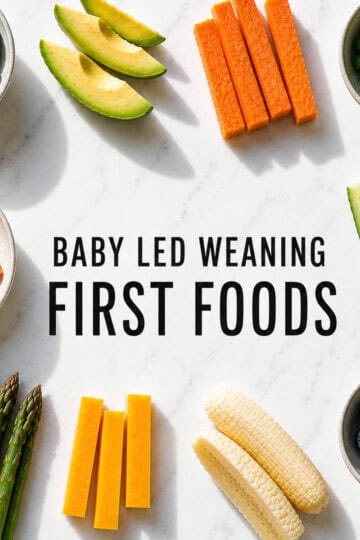
- Baby-led weaning (BLW) → your baby feeds themselves soft, whole foods by grasping and selecting them independently and joins in with family meals from the beginning (Brown & Lee, 2011)
- Purees → you offer smooth or mashed foods, typically spoon-fed
Both approaches aim to introduce solids alongside milk feeds- but they differ in how babies experience food early on.
It's also worth noting that these approaches aren't strictly separate. Many families naturally use a combination over time.
BLW vs Purees: Which Is Better for Babies?
The very short answer is: There's no clear "better" approach- both baby-led weaning and purees can support healthy development. Current research suggests that differences (like intake, skills and eating behavior) are often small and tend to even out over time.
In practice, the best approach usually comes down to what works for your baby, your routine, and what feels manageable and comfortable for you as a parent.
Below you'll find a quick comparison chart for an easy overview, and I'll go into more detail on each approach further down in the article.
| Aspect | Baby-Led Weaning (BLW) | Purees |
|---|---|---|
| How baby eats | Self-feeds soft, whole foods | Spoon-fed smooth or mashed foods |
| Independence | Encourages self-feeding early on | More caregiver-led at the start |
| Motor skills | May support fine motor development through practice | Skills develop gradually as textures progress |
| Intake clarity | Harder to tell how much is eaten | Easier to monitor intake |
| Mess level | More mess, especially early on | Generally less messy |
| Appetite regulation | May support responsiveness to hunger/fullness cues (limited evidence) | More caregiver control over intake |
| Food variety & textures | Early exposure to textures and family foods | Depends on how quickly textures are introduced |
| Convenience | Less separate prep if eating family meals | Easy to batch prep and freeze |
| Family meals | Baby joins from the start | May involve separate meals initially |
| Potential challenges | Less control, more mess, slower visible intake early on | Needs progression to textures to avoid delays |
Potential benefits of baby-led weaning
Encourages self-feeding, independence & motor skills
Baby-led weaning gives babies repeated opportunities to grasp, hold and manipulate food themselves. Some research suggests that babies following self-feeding approaches like BLW may develop more advanced fine motor and oral-motor skills, likely due to the repeated practice of handling food independently.
May support food acceptance
Some research suggests that baby-led weaning may be associated with lower levels of food fussiness (a measure of picky eating). It think that is has to mentioned though, that findings are based on parent-reported data and evidence is still limited.
Self regulation and satiety
Some findings, based on observational and parent-reported data, suggest that babies following a baby-led weaning approach may be more responsive to their own hunger and fullness cues, meaning they may be better at stopping when they are full. This may be linked to babies having more control over how much they eat (Brown & Lee, 2011; Townsend & Pitchford, 2012).
Encourages participation in family meals
One of the key aspects of baby-led weaning is that babies are offered modified versions of the same foods the rest of the family is eating. This means they can join in at the table from the very beginning, rather than having a separate "baby meal." In real life, this can make mealtimes feel more relaxed and inclusive but is a personal preference of course.
Can be more time-efficient
Personally, I found baby-led weaning to be more time-efficient, as there's often no need to prepare separate meals- when an appropriate piece of food is offered, babies can simply eat a modified version of what the rest of the family is having.
Potential disadvantages of baby-led weaning
Can be messy and unpredictable
This one is… self-explanatory 😅 Mealtimes can get messy, and outcomes are often a little unpredictable, especially in the beginning. In the early stages, food is often explored, squished, and enthusiastically thrown to the floor, which usually means a bit more cleaning- both of your baby and everything around them.
Less control over eaten amount
With baby-led weaning, it's often much harder to tell how much food was actually eaten, as a good portion of the food may be explored, squashed, dropped, or end up somewhere in the bib rather than eaten. This can feel stressful for parents who prefer having a bit more control or reassurance around how much their baby is actually consuming.
Potential benefits of purees
Easier to monitor intake
With spoon-feeding, parents often have a clearer sense of how many spoonfuls were actually swallowed. This can feel reassuring, especially in the early stages when intake is still small and unpredictable. Some research also suggests that spoon-feeding may result in slightly higher immediate intake of solids early on, as food is actively offered rather than self-fed. However, this difference does not seem to persist and overall energy intake tends to even out over time.
Can feel more structured and manageable
Purees often follow a more traditional, step-by-step approach- starting with smooth textures and gradually increasing complexity. For some parents, this might feel easier to manage and more predictable, particularly at the beginning.
Often convenient
Purees can be a convenient option, particularly in the early stages. They are easy to prepare, store, and serve, and many parents find them practical for meal prep- often making larger batches and freezing them in small portions for quick, ready-to-go meals. They can also be easier for other caregivers to offer.
Potential downsides of purees
May be linked to picky eating if textures are delayed
If purees are used for a prolonged period without gradually introducing more textured foods, this may delay exposure to different textures. Some research suggests that later introduction of lumpy or textured foods- particularly after around 9-10 months- may be associated with increased feeding difficulties or food selectivity later on (Northstone, Emmett, Nethersole (2001). This means that purees themselves aren't a problem but how long they're used without progression.
Can be harder to combine with family meals
Puree feeding often involves preparing separate meals for the baby, which can make it a bit more difficult to include them in shared family meals from the start. This may mean babies are exposed to family foods and textures later on.
Signs Your Baby Is Ready
Before choosing a method, readiness is key.
The American Academy of Pediatrics and the WHO recommend introducing solid foods at around 6 months of age, when most babies are developmentally ready. According to the NHS, babies are usually ready to start solids when they:
- Can sit up and hold their head steady
- Have good hand-eye coordination (can pick up food and bring it to their mouth)
- Can swallow food rather than push it back out
Is BLW Safer Than Purees?
Safety was honestly my biggest concern why I was hesitant of trying BLW in the first place.
Gagging vs Choking
- Gagging is a normal reflex in babies learning to eat
- Choking is serious and requires intervention
The research I found suggests that gagging may be more common in babies following a baby-led weaning approach, but there is no increased risk of choking compared to spoon-feeding. This means the feeding method itself does not seem to be the main factor influencing risk
What seems to matter more is
- how food is prepared
- whether high-risk foods are avoided
- and whether babies are properly supervised
That being said, for my own peace of mind, I still chose to take a baby first aid course so I'd feel confident knowing what to do in case of choking (Brown, 2017; Santos Silveira de Paiva et al., 2023; Białek-Dratwa et al., 2022).
BLW vs Purees for Nutrition
Here's a quick overview- I'll go into more detail below.
| Nutrient | BLW | Purees |
|---|---|---|
| Total Energy Intake | Lower early (balanced by higher milk intake) | Higher early |
| Solid Food Intake (6-9 mo) | Often much lower | Often much higher |
| (Saturated) Fat & Salt | Tendenially higher (from family meals) | Tendentially lower |
| Iron & Zinc, B12 & Calcium | Potential for lower intake | Often higher |
| Free Sugar | Often much lower (due to fewer processed foods) | Often higher (due to commercial jars/pouches) |
There are also some concerns around iron, zinc, calcium and vitamin B12 intake with BLW, as certain iron-rich foods can be harder to self-feed. However, when parents are mindful to include iron-rich finger foods, studies have not found clear differences in iron status compared to spoon-feeding.
Also, BLW infants may consume more, saturated fats and salt, likely due to eating more family foods. Studies also show that BLW infants consume significantly fewer commercial baby foods and pouches, resulting in a much lower intake of free sugars compared to spoon-fed infants.
In terms of energy intake overall, research suggests that BLW infants (aged 6-9 months) consumed significantly less energy from solid foods compared to spoon-fed infants. However, BLW babies compensated by taking in more calories from breast or formula milk, leading to similar overall energy levels (Daniels et al., 2018; Morison et al., 2016; Pearce et al., 2022, Jone Guenetxea-Gorostiza et al., 2025).
Overall, current research does not show a clear nutritional advantage of baby-led weaning over spoon-feeding, or vice versa. Many studies also highlight that the evidence is still limited and largely observational, meaning more long-term, high-quality research is needed to fully understand whether either approach leads to meaningful differences in nutrition over time.
Can You Do a Combination?
A mixed approach can offer flexibility, especially as babies develop and preferences change.
It's also possible to support independence even when offering purees- for example, by allowing babies to self-feed using a preloaded spoon once they're ready.
How to Choose What's Right for You
Instead of focusing on what's "best," it can help to think about what feels manageable.
BLW might suit you if:
- You're comfortable with self-feeding
- Your baby shows strong interest in grabbing food
- You enjoy the idea of shared meals
Purees might suit you if:
- You prefer a more gradual start
- You want more control over intake
- You feel more confident with spoon-feeding
A mixed approach might suit you if:
- You want flexibility
- Your baby responds well to both textures
- Your routine varies (e.g. home vs daycare)
BLW vs Purees: The Bottom Line
Both baby-led weaning and purees can support healthy growth and development.
What matters most is:
- Offering safe, appropriately prepared foods
- Including a variety of nutrients (especially iron, zinc, vitamin B12 and other key nutrients that can be lower if not planned for- particularly with BLW)
- Allowing your baby to explore at their own pace
There's no single "right" way to do this- just a way that works for you and your baby.
FAQs
While some research suggests that overall energy intake tends to even out by around 10-12 months regardless of feeding method (Rowan et al., 2022), more recent findings also indicate that babies following a baby-led weaning approach may consume similar amounts of energy compared to spoon-fed infants (Matzeller et al., 2024). Despite this, the lack of visible intake early on can still feel uncomfortable for some parents who prefer having a bit more control over how much their baby is eating.
It can be- if your baby is bringing the spoon to their mouth independently.
Yes, many families use different approaches depending on the setting.
Recipe Ideas
If you're looking for recipe ideas, my Baby Food Recipe series is perfect for this stage, as it breaks down individual ingredients- making it easier to introduce both fruits and vegetables one at a time. The recipes always include both puree and baby-led weaning instructions, so you can decide which approach to use (or even switch last minute depending on the day 😅).
Recipes include:
Sources
American Academy of Pediatrics. (n.d.). Starting solid foods. HealthyChildren.org.
https://www.healthychildren.org/English/ages-stages/baby/feeding-nutrition/Pages/Starting-Solid-Foods.aspx
Andries e Arantes et al. (2018). The baby-led weaning method (BLW) in the context of complementary feeding: A review. Revista Paulista de Pediatria, 36(3), 353-363.
Alpers, B., Blackwell, V., & Clegg, M. E. (2019). Standard vs. baby-led complementary feeding: A comparison of food and nutrient intakes in 6-12-month-old infants in the UK. Public Health Nutrition, 22(15), 2813-2822.
Białek-Dratwa, A., Kowalski, O., & Szczepańska, E. (2022). Traditional complementary feeding or BLW (Baby-Led Weaning) method? - A cross-sectional study of Polish infants during complementary feeding. Frontiers in Pediatrics, 10, 992244.
Białek-Dratwa, A., et al., (2025). Baby-led weaning vs. traditional complementary feeding- Differences in feeding practices among Polish children aged 6-36 months: A cross-sectional study. Nutrients, 17(5), 899.
Brown, A. (2018). No difference in self-reported frequency of choking between infants introduced to solid foods using a baby-led weaning or traditional spoon-feeding approach. Journal of Human Nutrition and Dietetics, 31(4), 496-504.
Brown, A., & Lee, M. (2011). A descriptive study investigating the use and nature of baby-led weaning in a UK sample of mothers. Maternal & Child Nutrition, 7(1).
Brown, A., & Lee, M. D. (2013). Early influences on child satiety-responsiveness: The role of weaning style. Pediatric Obesity.
Coulthard, H., Harris, G., & Emmett, P. (2009). Delayed introduction of lumpy foods to children during the complementary feeding period affects child's food acceptance and feeding at 7 years of age. Maternal & Child Nutrition, 5(1), 75-85.
Fu, X., et al (2018). Food fussiness and early feeding characteristics of infants following baby-led weaning and traditional spoon-feeding in New Zealand: An internet survey. Appetite, 130, 110-116.
Guenetxea-Gorostiza, J. et al., (2025). Nutrient intake and fruit and vegetable offering in baby-led weaning compared with parent-led weaning in healthy 6- to 13-month-old infants: A systematic review and meta-analysis. Nutrition, 137, 112812.
Matzeller, K., et al. (2024). Infants following baby-led weaning had increased growth trajectories compared to conventional weaning while consuming similar energy. Current Developments in Nutrition, 8, 103012.
Morison, B. J., et al. (2016). How different are baby-led weaning and conventional complementary feeding? A cross-sectional study of infants aged 6-8 months. BMJ Open, 6(5), e010665.
Northstone, K., & Emmett, P. M., Nethersole F. (2001). The effect of age of introduction to lumpy solids on foods eaten and reported feeding difficulties at 6 and 15 months. Journal of Human Nutrition and Dietetics, 14(1), 43-54.
NHS. (n.d.). Your baby's first solid foods. NHS.
https://www.nhs.uk/conditions/baby/weaning-and-feeding/babys-first-solid-foods/
Rowan, H., Harris, C., & Alder, E. (2022). Energy and nutrient intake in infants following baby-led weaning and traditional spoon-feeding approaches. Journal of Human Nutrition and Dietetics, 35(2), 325-336.
Rowan, H., Lee, M., & Brown, A. (2022). Estimated energy and nutrient intake for infants following baby-led and traditional weaning approaches. Journal of Human Nutrition and Dietetics, 35(2), 325-336.
Pearce, J., Langley-Evans, S. C., & (2022). Comparison of food and nutrient intake in infants aged 6-12 months following baby-led or traditional weaning: A cross-sectional study. Journal of Human Nutrition and Dietetics, 35(2), 310-324.
Pecora, G. et al. (2026). Self-feeding and communicative development from 12 to 24 months. Child Development, 97(1), 21-37.
Santos Silveira de Paiva, C. et al. (2023). Choking, gagging and complementary feeding methods in the first year of life: a randomized clinical trial. Jornal de Pediatria (Rio J), 99(6), 574-581.
Townsend, E., & Pitchford, N. J. (2012). Baby knows best? The impact of weaning style on food preferences and body mass index in early childhood in a case-controlled sample. BMJ Open, 2(1), e000298.
World Health Organization. (n.d.). Complementary feeding. World Health Organization.
https://www.who.int/health-topics/complementary-feeding#tab=tab_2
Disclaimer
The information in this article is based on my own research and is intended for general informational purposes only. It should not be considered medical advice. Always consult your pediatrician or a qualified healthcare professional if you have any questions about your baby's feeding or development.