Baby Led Weaning Essentials
Starting baby led weaning can feel a little overwhelming. There are enough blw supplies out there to fill an entire kitchen cupboard. The good news? You really don't need that much to get started.
In this guide, I'm sharing products that turned out to be baby led weaning must-haves for me. I'll walk you through the minimalist BLW setup I'd recommend to any parent, the feeding products I personally used and loved most, some helpful extras and a few fun tools that can make meals a little more exciting for picky eaters.
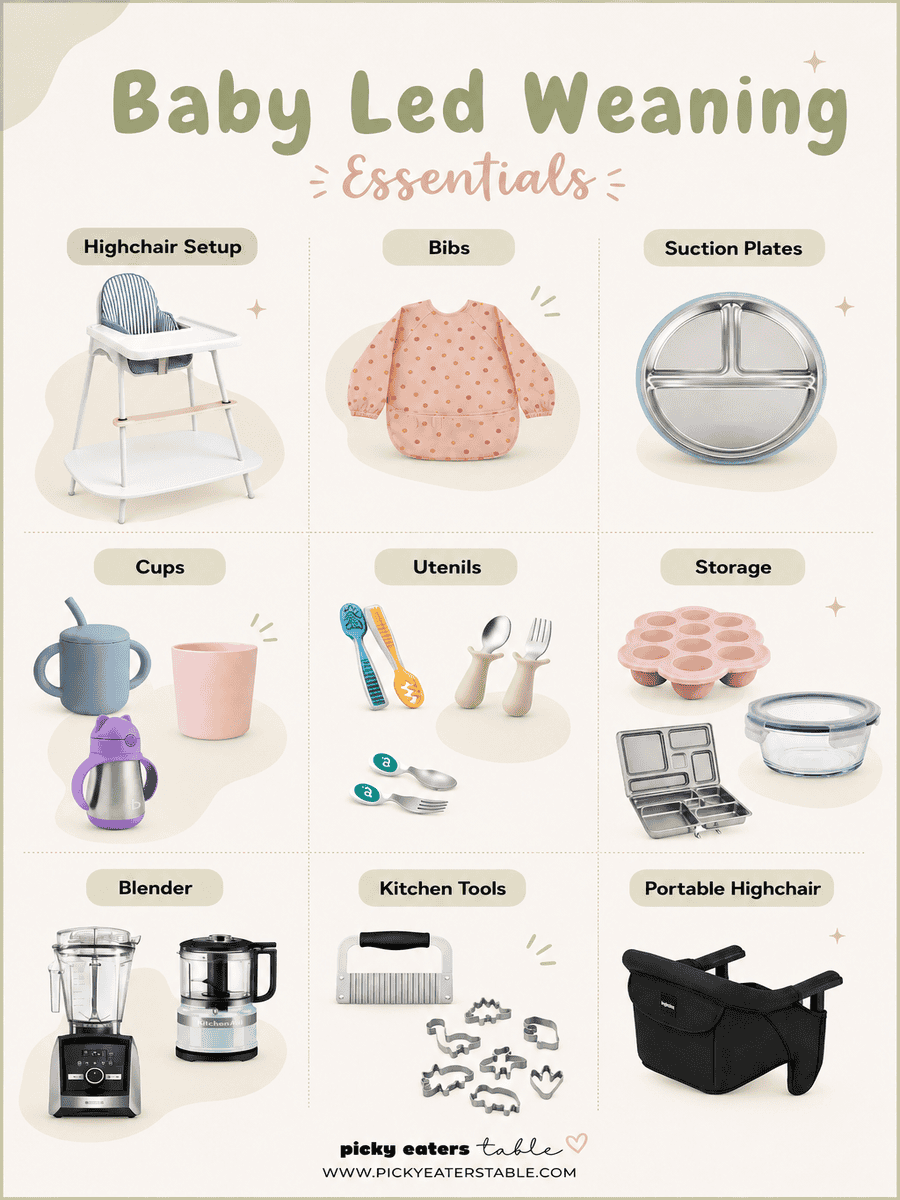
Quick overview
If you're short on time, I've included a quick overview of my tried-and-true weaning essentials below. These are the products we personally used and loved throughout our feeding journey. Further down, I'll dive into each category in more detail.
| Category | Products I Used |
|---|---|
| Highchair + equipment | Stokke Trip Trapp Setup Ikea Antilop + Antilop Footrest Catchy |
| Portable Highchair | Inglesina Black Fast Table Chair |
| Bibs | Tiny Twinkle Long Sleeve Bib |
| Pre Loaded Spoons | NumNum Baby Spoons |
| Plates | WeeSprout Silicone Divided Suction Plates with Lids Elk & Friends Stainless Steel Plates |
| Cups (Open + Straw) | Mushie Silicone Training Cup (at home + used as an open cup without the lid) Munchkin Straw Cup (out and about) |
| Utensils | PandaEar Spoon & Fork Set Doddl Toddler Utensils |
| Food storage | WeeSprout Silicone Freezer Trays IKEA 365+ Food Containers |
| Lunchbox | PlanetBox Rover Stainless Steel Lunchbox |
| Kitchen tools | Crinkle Cutter OXO Tot Grape Cutter Dinosaur Cookie Cutters |
Before you buy: things to consider
Before filling your cart with bowls, plates, and utensils, there are a few things that I've learned over the years, that I'd keep in mind. I found that factors like materials, ease of cleaning, and durability mattered far more than having the prettiest feeding set.
- Choose safe, durable materials: When it came to baby feeding products, I tried to stick to food-grade silicone and stainless steel whenever possible. Silicone is soft, durable, lightweight, and gentle on little gums and stainless steel is incredibly durable, doesn't stain, won't absorb food odors, and can last well beyond the baby years. While many plastic feeding products are labelled BPA-free and are perfectly safe to use, I generally preferred these two options.
- Choose easy-to-clean products: You'll be washing these items several times a day, so easy cleaning quickly becomes a top priority. Look for products that are dishwasher-safe, easy to take apart and free from tiny crevices where food can get trapped. This is especially important when choosing straw cups.
- Think about longevity: Some feeding products are only useful for a few months, while others can grow with your child. A good highchair, stainless steel cups, and quality utensils can often be used for years rather than months.
- Less is often more: It's easy to get carried away and buy an entire feeding set before your baby has even tasted their first piece of avocado. In reality, most babies only need a few basics to get started. You can always add more later if needed.
Feeding essentials at a glance
Here's a quick overview of what I would call "the minimalist setup", the setup we used and loved and some BLW essentials for on the go.
The minimalist setup
- Highchair with foot support
- Highchair tray
- Long sleeve bib
- Open cup
- Silicone pre-loaded spoon
- One bowl or plate
The setup I loved
Everything from the Minimalist Setup, plus:
- Catchy (my secret weapon)
- Straw cup for outings
- One or two suction bowls/plates
- Toddler spoon + fork
Helpful extras
- (Stick) blender/ food processor
- Silicone freezer trays
- Glass food storage containers
- Snack containers
- Portable highchair / travel highchair
Picky eater tools
- Crinkle cutter
- Mini cookie cutters
- Animal-shaped sandwich cutters
- Divided plates
- Bento-style lunch boxes
The minimalist BLW setup
If you want to keep things simple, these are the only baby led weaning essentials I'd consider truly necessary for getting started.
Highchair
There are so many to choose from. One of the most overlooked baby led weaning essentials is proper foot support. Babies eat best when they're sitting upright, stable, and comfortable. If their feet are dangling freely, it can be harder for them to maintain good posture during meals.
We have both a Stokke Tripp Trapp and an IKEA Antilop highchair, and both have worked really well for us. One thing I love about the Tripp Trapp is that it grows with your child, so you can continue using it for years.
The IKEA Antilop is a fantastic budget-friendly option, although you may want to add an aftermarket footrest if your baby needs extra support. You can find footrests (and other accessories) for the Antilop from brands like Yeah Baby Goods and other baby accessory retailers.
Highchair Tray
For both highchairs, we purchased the tray attachment. I found this especially useful in the beginning because it gave my daughter her own eating space and was incredibly easy to wipe clean after meals. I also bought the silicone placemat designed for the IKEA tray but I barely used it tbh.
Long Sleeve, Waterproof Bibs
These were one of my most-used BLW essentials. Unlike silicone bibs, these long sleeve bibs protected my daughter's sleeves and clothes as well, which meant far fewer outfit changes.
Silicone pre-loaded spoons
Perfect for practicing self-feeding. Don't be surprised if your baby mostly uses their hands at first though- that's completely normal. We loved these Num Num Baby Spoons.
Open cups
We introduced an open cup from the very beginning and used it at most meals. Yes, it requires a little more supervision (and cleanup!), but I just preferred them.
For an open cup, I preferred materials like stainless steel or silicone whenever possible. I found that some silicone cups could develop a slight odor if water sat in them for too long, whereas stainless steel never seemed to have that issue.
One option we liked were this Nuby Silicone Cup, the ezpz Tiny Silicone Cup, Mushi Silicone Starter Cup. Stainless steel ones included this Bakpoco 2-IN-1 Open Baby Cups and Elk and Friends Stainless Steel Kids.
The setup I personally loved
We used everything from the minimalist BLW setup, plus the following items. Over time, they became some of our most-used baby led weaning essentials.
My secret weapon: The Catchy
One of my favorite baby led weaning purchases was the Catchy.
Invented by an Australian couple, it attaches underneath the highchair and catches dropped food, spoons, cups, and all the other things your baby inevitably throws on the floor. Not only does it make cleanup much easier, but it also saves you from constantly bending down throughout the meal.
Budget-friendly alternative: A waterproof splat mat or even a clear office chair mat underneath the highchair can also help protect your floors and make cleanup quicker.
Straw cups
I didn't use traditional sippy cups. Instead, we used an open cup at home and a straw cup for car journeys, walks, travel, and eating out. If there's one thing I unexpectedly became an expert on during baby led weaning, it's straw cups. 😅 I spent an almost embarrassing amount of time researching them because I was determined to find one that ticked all my boxes:
- A stainless steel container: I found it didn't absorb odors the way some silicone cups occasionally could if water sat in them for too long.
- A silicone straw or mouthpiece: I preferred avoiding hard plastic where my daughter was actually drinking (and chewing!) from.
- A covered flip lid: It simply felt more hygienic when we were out and about since the straw wasn't constantly exposed in the stroller, diaper bag, or car.
- Easy cleaning: I wanted something that could be taken apart easily.
- Dishwasher-safe components: Because hand-washing tiny cup parts every day wasn't something I was interested in.
- Replacement parts: Being able to buy replacement straws and mouthpieces separately was a huge bonus and often much cheaper than replacing the entire cup.
- One more thing to consider: When shopping for a straw cup, you'll also come across two different straw styles. Which one you choose really comes down to personal preference and what works best for your baby. If your little one struggles with one style, it's often worth giving the other a try.
- Free-flowing straws: Water comes up the straw freely, much like drinking from a regular straw. These tend to have fewer parts and are often easier to clean.
- Valved straws: Babies need to suck, bite, or apply pressure to release the liquid. These are often more spill-resistant and can allow babies to drink from a wider range of angles.
| Product | Container Material | Straw Material | Straw Type | Covered Straw? | Dishwasher Safe? | Replacement Parts Available? |
|---|---|---|---|---|---|---|
| Pura Stainless Steel Straw Bottle | Stainless steel | Silicone | Free-flowing | ❌ | ✅ | ✅ |
| Thermos FUNtainer | Stainless steel | Silicone | Free-flowing | ✅ | ✅ | ✅ |
| BEABA Stainless Steel Straw Cup | Stainless steel | Silicone | Valved | ✅ | ✅ | ✅ |
| Munchkin Cool Cat Stainless Steel Straw Cup | Stainless steel | Silicone | Valved | ✅ | ✅ | ✅ |
| Elk & Friends Stainless Steel Cup | Stainless steel | Silicone | Free-flowing | ❌ | ✅ | ✅ |
| Zak Designs Kelso Stainless Steel Cup | Stainless steel | Silicone | Valved | ❌ | ✅ | ✅ |
| Weesprout3-in-1 Stainless Steel Cups for Kids | Stainless steel | Silicone | Free-flowing | ❌ | ✅ | ❌ |
| EZPZ Mini Cup + Straw Training System | Silicone | Silicone | Free-flowing | ❌ | ✅ | ❌ |
| WeeSprout Silicone Baby Cups With Straws | Silicone | Silicone | Free-flowing | ❌ | ✅ | ❌ |
| Mushie Silicone Training Cup | Silicone | Silicone | Free-flowing | ❌ | ✅ | ❌ |
| Munchkin Any Angle Weighted Straw Cup | Plastic | Silicone | Valved weighted straw | ✅ | ✅ | ✅ |
| OXO Tot Transitions Straw Cup | Plastic | Silicone | Valved | ✅ | ✅ | ✅ |
| Philips Avent Straw Cup | Plastic | Silicone | Valved | ✅ | ✅ | ✅ |
Which straw cup is right for you?
The best cup depends on your priorities and, just as importantly, your baby's preferences. After all, it doesn't matter how carefully you researched materials if your little one refuses to drink from it.
For me, a covered straw and stainless steel container were high on the priority list because we only used straw cups when we were out and about. At home, we stuck to open cups. Your priorities may look completely different depending on how and where you plan to use your cups.
Below are my top picks depending on what matters most to you. 😊
| If you want... | My Pick(s) |
|---|---|
| Amazing materials & a cup that grows with your child | Pura Kiki |
| A covered straw + stainless steel for travel | Thermos FUNtainer, BEABA, Munchkin Cool Cat |
| A stainless steel cup for home use (no covered straw) | Pura Kiki, Elk & Friends, WeeSprout |
| The easiest cup for younger babies learning straws | Munchkin Any Angle Weighted Straw Cup |
| The most spill-resistant options | Munchkin Any Angle, Zak Stainless Steel Cup, OXO Tot, Philips Avent |
| A silicone training cup for starting out | EZPZ Mini Cup + Straw, Mushie Training Cup |
Suction bowls & plates: are they worth it?
I personally liked having one or two suction bowls or plates on hand, especially for messier meals. That said, don't expect them to be completely toddler-proof. While the suction can help prevent bowls and plates from immediately ending up on the floor, many little ones eventually figure out how to remove them. For finger foods, we often skipped the plate altogether and simply served food directly on the highchair tray.
When choosing a suction plate, I'd personally look for two features:
- Divided sections: I found these helpful for serving foods with different tastes, textures, or temperatures without everything mixing together.
- A matching lid: Surprisingly useful for storing leftovers or covering a meal to offer again later if your little one suddenly decides they're finished after three bites.
Examples include:
- WeeSprout Suction Plates (silicone + lid)
- PandaEar Suction Plates (stainless steel + lid)
- Elk and Friends Divided Plates (stainless steel + lid)
- ezpz Mini Mat (silicone, no lid)
- Munchkin Bamboo Suction Plate (bamboo, no lid)
- OXO Tot Stick and Stay Suction Divided Plate (plastic, no lid)
My biggest tip to make suction bowls work: Before placing the bowl or plate on the tray, lightly dampen the suction base with a few drops of water. This creates a much stronger seal and helps the suction actually work as intended.
Baby Led Weaning Utensils
There are so many baby forks and spoons to choose from! For the first few months, I found pre-loaded spoons the most useful. Once our baby became more interested in using utensils independently, we introduced a fork and spoon set.
When choosing baby cutlery, I'd personally look for
- Short, chunky handles that are easy for little hands to grip
- Stainless steel tips once your baby gets older and starts practicing with a fork more seriously
- Dishwasher-safe materials
We used the one from PandaEar and especially liked the doddl Toddler Utensils the most.
Helpful feeding extras
None of these are essential for starting solids, but they can make meal prep, food storage, and feeding on the go much easier.
Meal prep & food storage
- Blender, stick blender, or food processor: Useful for making any type of baby food recipes such as purees, dips, smoothies, sauces, or baby-friendly versions of family meals.
- Grape cutter: This grape cutter from OXO Tot quarters grapes for safer snacking very easily.
- Silicone freezer trays: such as the ones from WeeSprouts. Perfect for freezing leftover purees, sauces, mashed foods, and small portions.
- Freezer-friendly glass food storage containers: Great for storing larger portions, muffins, pancakes, fritters, and meal-prepped lunches. I preferred glass because it doesn't stain or absorb odors. Make sure they are freezer friendly!
- Snack containers: Handy for packing fruit, crackers, muffins, energy balls, or other toddler snacks when leaving the house.
Feeding on the go
- Portable highchair (hook-on or travel highchair): We found this incredibly useful when travelling, visiting friends and family, or eating at restaurants that didn't have a suitable highchair available. It takes up very little space and can make mealtimes away from home much easier. An example would be this highchair from Inglesia.
Mealtime tools for picky eaters
Before buying lots of picky-eater gadgets, remember that presentation only goes so far. Sometimes a crinkle-cut cucumber works magic, and other times your toddler still refuses it despite the star shape. I find these tools work best as a way to make familiar foods feel a little more fun rather than as a solution for picky eating itself.
- Crinkle cutter: Probably my favorite item in this category. It instantly makes fruits, vegetables such as potatoes and tofu look more interesting with almost no extra effort. It also cuts most veggies into the perfect size for BLW.
- Mini cookie cutters: Perfect for turning pancakes, cheese, watermelon, cucumber, and other foods into fun shapes like stars, hearts, or flowers.
- Animal-shaped sandwich cutters and presses: Completely unnecessary, but surprisingly effective for some toddlers. 😅 I sometimes make veggie nuggets in the shape of dinosaurs, and they're often much more exciting than the regular version.
- Divided plates: Some children prefer foods separated rather than touching each other, especially during picky eating phases.
- Bento-style lunch boxes: The same goes for lunch boxes. Perfect for serving a variety of small foods and creating "snack plate" style meals.
My biggest tips
- Start with the basics and build from there: Start with a few essentials and add more as you discover what works for your baby and your family.
- Focus on easy-to-clean products: You'll be washing these items multiple times a day. Dishwasher-safe products and feeding gear with fewer parts can save a surprising amount of time and frustration.
- Choose products that grow with your child: Whenever possible, look for items that can be used beyond the baby stage. Highchairs, stainless steel cups, quality utensils, and glass storage containers can often be used for years.
- You don't need baby-specific versions of everything: Many families end up using the same glass food containers, snack boxes, and kitchen tools they already own rather than buying separate baby products for every stage.
- Remember that every baby is different: The "perfect" cup, spoon, or plate on paper isn't very useful if your child refuses to use it. Sometimes a little trial and error is unavoidable.